

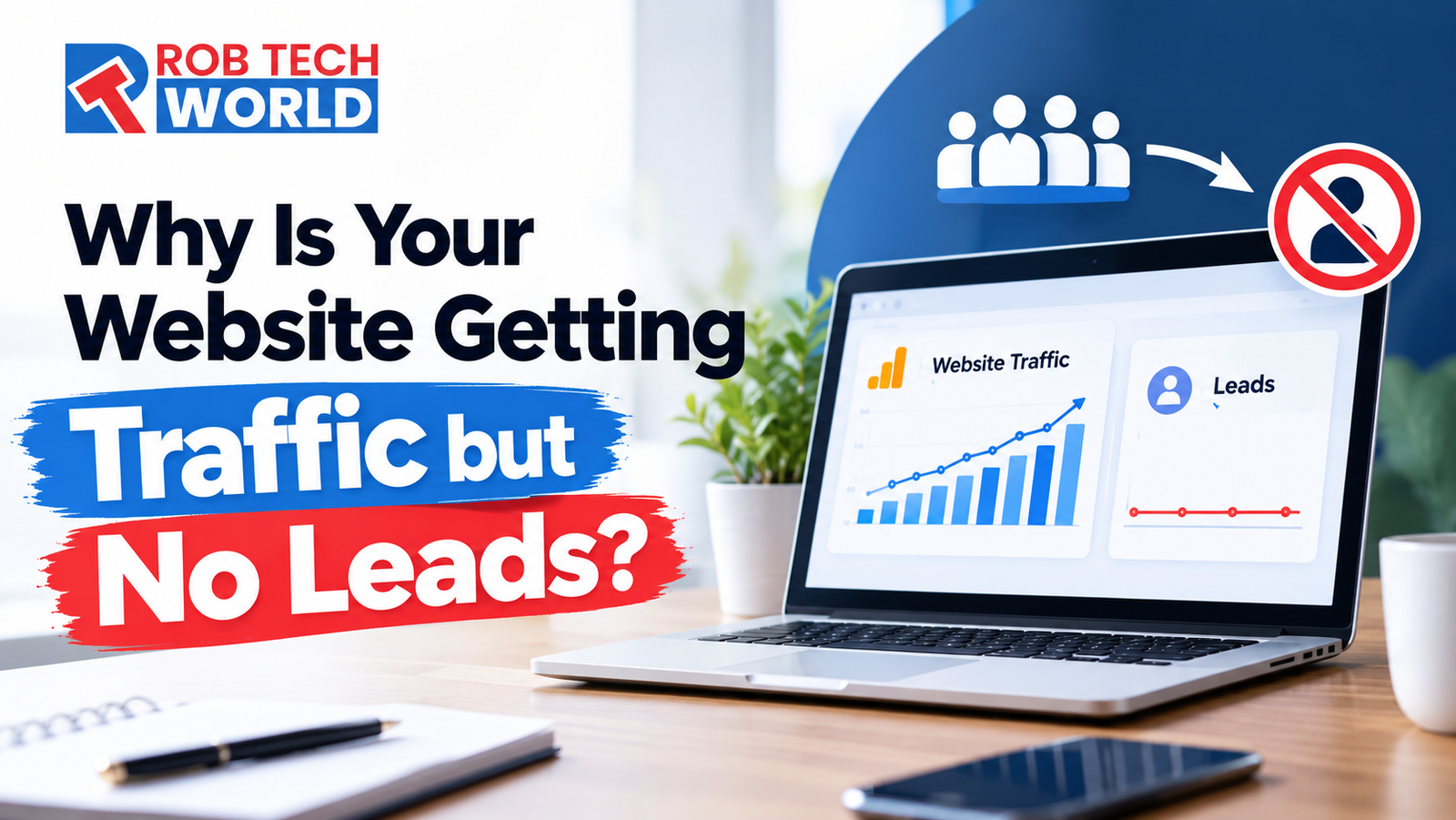

A Website Getting Traffic but No Leads is a common challenge for businesses investing in SEO, paid advertising, and digital marketing. Your website may attract visitors through Google Search, social media, or online campaigns, yet those visitors leave without filling out a form, calling your team, or making a purchase. This gap between website traffic and lead generation often indicates that something in your marketing strategy or website experience needs improvement.
The good news is that more traffic is not always the solution. Businesses need to attract the right audience, communicate their value clearly, build trust, and make it easy for visitors to take action. Understanding why users are not converting can help you turn existing traffic into meaningful business opportunities.
1. Are You Attracting the Right Website Visitors?
One of the biggest reasons a website receives traffic without generating leads is a mismatch between its audience and its services. High visitor numbers may look encouraging, but they have limited business value if those visitors are not interested in what you offer.
For example, a company selling premium software may attract students searching for free tools. Similarly, a local service provider may receive visitors from locations it does not serve.
How to Identify the Wrong Traffic?
Review your website analytics to understand which pages attract visitors, where they come from, what search terms they use, and whether they engage with your content.
Pay attention to the following indicators:
- Search intent: Are visitors researching a topic, comparing solutions, or ready to purchase?
- Geographic relevance: Are users visiting from areas where your business operates?
- Audience quality: Do your landing pages address the needs of your ideal customers?
- Engagement patterns: Do visitors explore relevant pages or leave without interacting?
Refine your SEO keywords, advertising audience, and content strategy to attract people who are more likely to become customers.
2. Does Your Website Match Search Intent?
Even when your website attracts relevant visitors, it may fail to meet their expectations. Search intent refers to the reason behind a user’s query. Someone searching for information generally needs a different experience from someone looking for a service provider.
For instance, a person searching for website design tips expects useful guidance, while someone searching for a web development company may want service details, project examples, and a consultation option.
If your page does not satisfy the intent behind the search, visitors may return to Google and choose another result.
Align Your Content With Visitor Needs
Create dedicated pages for different audience needs. Informational pages should answer questions clearly, while service pages should explain your solutions, process, benefits, and next steps.
Review the search results for your target keywords to understand what users expect to find. Then make sure your page delivers that information without unnecessary content or confusing messaging.
3. Is Your Website’s Value Proposition Clear Enough?
Visitors often decide within seconds whether a website deserves their attention. If they cannot quickly understand what your business offers, who it helps, and why they should choose you, they may leave without exploring further.
A vague headline such as “Innovative Solutions for a Better Future” does not tell potential customers what they can expect. A specific headline that explains the service and its benefit is much more useful.
Make Your Main Message Easy to Understand
Your homepage and service pages should communicate three essential points:
- What products or services do you provide?
- Which problems do you solve for customers?
- What makes your business a suitable choice?
Use a clear headline, a concise supporting paragraph, and a relevant call to action above the fold. Avoid technical jargon unless your audience expects it.
Your messaging should focus on customer outcomes rather than simply listing company capabilities. When visitors understand your value, they have a stronger reason to take the next step.
4. Are Your Calls to Action Easy to Find?
A website can have excellent content and attractive design but still struggle to generate leads if visitors do not know what to do next.
A call to action (CTA) guides users towards a specific action, such as requesting a quote, scheduling a consultation, downloading a resource, or contacting your sales team.
Improve Your Website’s Conversion Opportunities
Place relevant CTAs where visitors are likely to need them. For example, a service page can include a consultation button after explaining the benefits of the service, while a product page can feature a prominent purchase button.
Consider these improvements:
- Use action-oriented text such as “Request a Free Quote” or “Book a Consultation.”
- Make buttons visually distinct from surrounding content.
- Repeat the primary CTA at suitable points on longer pages.
- Keep contact information easy to access.
- Match each CTA to the visitor’s stage in the buying journey.
Avoid overwhelming users with multiple competing actions. One clear primary CTA, supported by relevant secondary options, can create a more focused experience.
5. Is Your Website Slow or Difficult to Use?
Website performance has a direct impact on user experience. Visitors may abandon a page if it loads slowly, displays incorrectly, or makes important information difficult to find.
Mobile usability is particularly important because many users browse websites on smartphones. Small buttons, oversized images, intrusive pop-ups, and complicated navigation can prevent visitors from contacting your business.
Check Your Website’s Technical Performance
Use tools such as Google PageSpeed Insights and Google Search Console to identify performance and usability issues.
Review these areas regularly:
- Loading speed: Compress images, reduce unnecessary scripts, and improve server performance where needed.
- Mobile responsiveness: Ensure layouts, text, forms, and buttons work on different screen sizes.
- Navigation: Organise menus so visitors can find services and contact information quickly.
- Technical errors: Fix broken links, malfunctioning buttons, and pages that fail to load.
- Accessibility: Use readable text, sufficient contrast, and clearly labelled form fields.
Google’s Core Web Vitals can help you evaluate loading performance, responsiveness, and visual stability. Although strong performance does not guarantee conversions, a smoother experience removes unnecessary barriers.
6. Does Your Website Build Trust With Visitors?
Potential customers may hesitate to contact a business if they cannot verify its credibility. This is especially common when the service involves a significant investment, personal information, or a long-term business relationship.
A website that makes impressive claims without supporting evidence may leave visitors uncertain about whether the company can deliver.
Add Trust Signals That Support Your Claims
Help visitors evaluate your business by providing genuine, relevant evidence of your experience and reliability.
Useful trust signals include:
- Authentic customer reviews and testimonials.
- Case studies explaining the challenge, solution, and results.
- Relevant qualifications, certifications, or industry memberships.
- Clear business contact details and company information.
- A transparent description of your process, pricing approach, or service terms.
- A portfolio showing relevant completed projects.
Do not rely on generic claims such as “number one” or “best in the industry” without evidence. Specific, verifiable information is more persuasive.
Trust elements should appear near important conversion points, such as enquiry forms, service descriptions, and pricing information.
7. Are Your Landing Pages Designed to Convert?
Sending every visitor to your homepage is not always effective. A homepage usually introduces the business broadly, whereas a landing page can focus on one service, audience, or campaign.
For example, someone clicking an advertisement for e-commerce development should land on a page that explains your e-commerce services, relevant experience, and enquiry options—not a general page that forces them to search for the advertised service.
Remove Unnecessary Conversion Barriers
A focused landing page should include a relevant headline, clear benefits, supporting proof, and a straightforward next step.
Keep enquiry forms short. Ask only for information your team genuinely needs at the initial stage. Requiring too many details can discourage interested visitors from completing the form.
Also, ensure that the message in your advertisement matches the landing page. If an ad promises a particular service or offer, visitors should find it immediately after clicking.
8. Are Your Lead Forms Working Properly?
Sometimes the problem is not your marketing strategy but a technical issue that prevents users from submitting enquiries successfully.
A form may look correct while failing to send notifications, displaying confusing error messages, or malfunctioning on certain devices. Phone numbers, email links, and booking tools can also stop working after website updates.
Test the Entire Enquiry Process
Submit test enquiries from desktop and mobile devices. Confirm that the form displays a success message and that the enquiry reaches the correct inbox or customer relationship management (CRM) system.
Check for required fields that are unclear, CAPTCHA issues, validation errors, and slow submission times. Monitor spam filters and email delivery as well.
Track successful form submissions rather than counting button clicks alone. This helps you distinguish genuine leads from visitors who start but never complete the process.
9. Are You Measuring the Right Conversion Metrics?
Website traffic alone cannot explain whether your marketing efforts are producing business results. You need to measure what visitors do after arriving on your website.
Google Analytics 4 (GA4) and Google Search Console provide different but complementary insights. Search Console helps you understand search visibility, clicks, and search queries, while GA4 can measure website engagement and configured conversion events.
Track the Metrics That Matter for Lead Generation
| Metric | What it helps you understand |
|---|---|
| Traffic source | Which channels attract visitors |
| Landing page conversions | Which pages generate enquiries |
| Conversion rate | What percentage of visitors complete a desired action |
| Form abandonment | Where potential leads drop out of the process |
| Cost per lead | How much paid marketing spends to generate a lead |
| Lead quality | Whether enquiries match your target customers |
Calculate your conversion rate by dividing the number of conversions by the number of eligible visitors or sessions measured, then multiplying by 100. Keep the denominator consistent when comparing performance over time.
For example, if 1,000 website sessions produce 20 enquiries, the session-based enquiry conversion rate is 2%.
Review results by channel, landing page, device, and audience segment. This makes it easier to identify where improvements can have the greatest impact.
10. How Can You Turn More Website Visitors Into Leads?
Improving lead generation works best when you address the most significant barriers first rather than changing everything at once.
Start with a practical optimisation plan:
- Audit traffic quality: Identify whether visitors match your target audience and service locations.
- Review landing pages: Check whether content satisfies search intent and explains your value.
- Improve CTAs: Make the next step clear and easy to complete.
- Fix technical problems: Test page speed, mobile usability, forms, and contact links.
- Strengthen trust: Add authentic reviews, case studies, and relevant proof.
- Measure conversions: Configure accurate tracking for forms, calls, bookings, and purchases.
- Test improvements: Change one important element at a time and compare results over a meaningful period.
Prioritise changes using analytics and customer feedback. A page with substantial relevant traffic but few enquiries may deserve attention before a page that receives very few visitors.
Rob Tech World helps businesses approach digital growth through SEO, website development, e-commerce solutions, and other digital marketing services. A coordinated strategy can help identify performance gaps and improve the path from discovery to enquiry.
Frequently Asked Questions
1. Why Is My Website Getting Traffic but No Leads?
Your website may attract visitors who are not ready to buy, target the wrong audience, or fail to communicate a clear value proposition. Weak calls to action, poor mobile usability, limited trust signals, and technical problems can also reduce enquiries. Review traffic quality, landing pages, and conversion tracking to identify the main issue.
2. What Is a Good Website Conversion Rate for Lead Generation?
There is no universal conversion rate that suits every business. Results vary by industry, traffic source, service price, audience intent, and the type of conversion being measured. Establish a reliable baseline, compare similar pages and channels, and work towards measurable improvements in both conversion rate and lead quality.
3. How Can I Get More Leads Without Increasing Website Traffic?
Improve the experience for visitors who already reach your website. Make service benefits clearer, simplify enquiry forms, strengthen calls to action, display authentic customer reviews, and resolve technical issues. Test these changes and track completed enquiries to determine which improvements produce meaningful results.
4. Does Website Design Affect Lead Generation?
Yes. Website design influences navigation, readability, mobile usability, credibility, and how easily visitors complete important actions. A professional, accessible design can remove friction and support conversions. However, design alone cannot guarantee leads; audience relevance, useful content, service quality, and a clear offer also matter.
5. How Long Does It Take to Improve Website Lead Generation?
Some issues, such as broken forms or unclear CTAs, can be corrected quickly. Other improvements, including SEO changes, audience refinement, and conversion testing, may require several weeks or longer to evaluate reliably. The timeline depends on website traffic, the scale of changes, and how frequently meaningful conversions occur.
Turn Your Website Traffic Into Business Opportunities
If your website attracts visitors but struggles to generate enquiries, it may be time to look beyond traffic numbers and examine the complete user journey. The right combination of relevant content, clear messaging, technical performance, trust-building elements, and conversion tracking can help you make better use of your existing audience.
Ready to improve your website’s lead generation? Contact Rob Tech World to discuss your website, SEO, and digital marketing goals. Identify conversion barriers, strengthen your online presence, and build a strategy focused on attracting the right visitors and turning more of them into potential customers.