


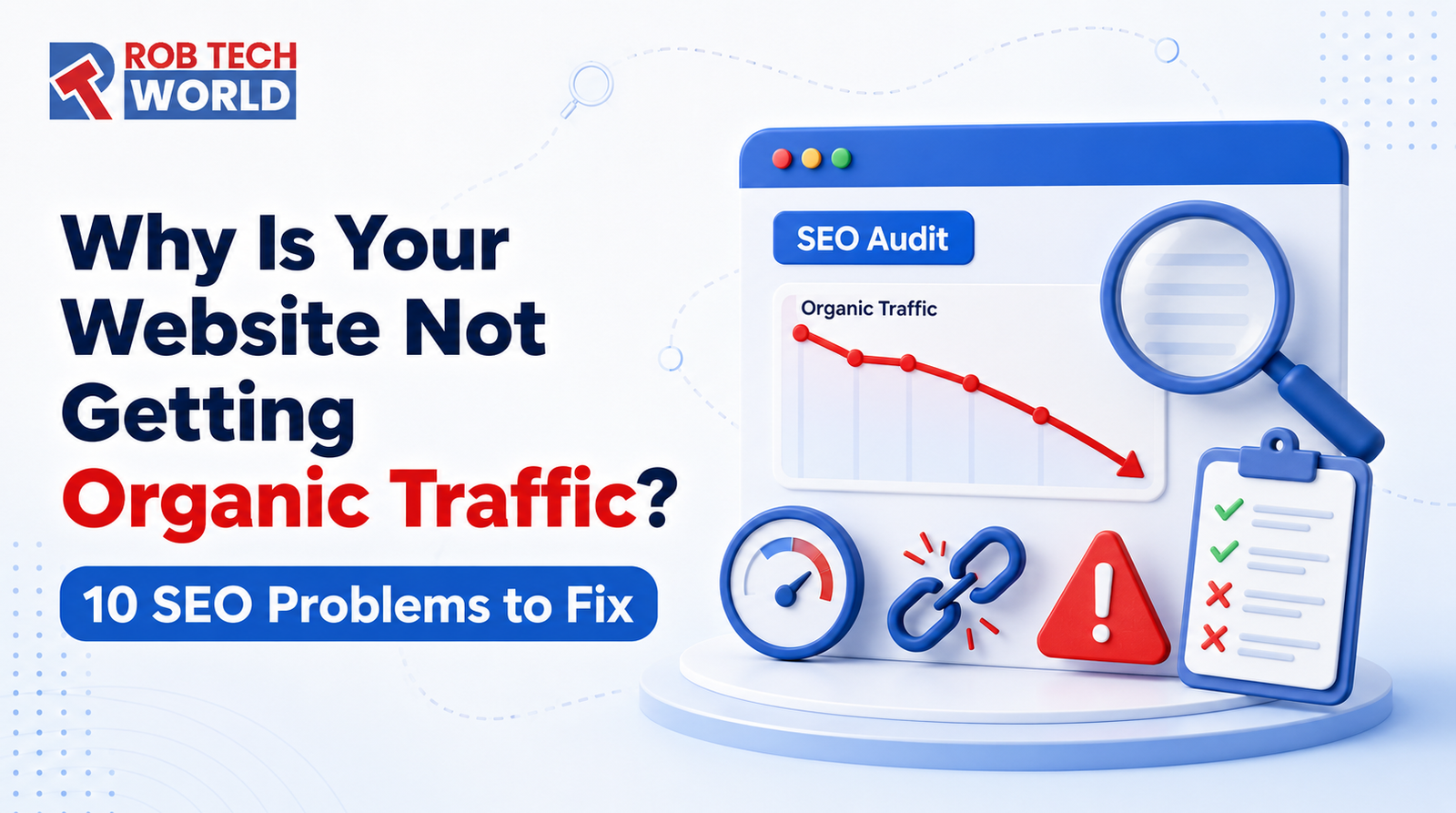
Getting a website online is only the first step toward building a strong digital presence. Many businesses invest in a professionally designed website, publish content, and offer valuable products or services, yet still struggle to attract visitors from Google. If your website is not receiving consistent organic traffic, the problem may not be a lack of effort. In many cases, technical issues, weak content, poor keyword targeting, or an outdated SEO strategy can prevent your pages from reaching the right audience. Finding and fixing these issues with a well-planned SEO approach can help improve search visibility and bring more relevant visitors to your website.
Organic traffic does not usually increase overnight. Search engines evaluate many signals before deciding which pages deserve prominent positions in search results. Your website needs to be accessible, relevant, trustworthy, useful, and easy to understand. When one or more of these areas are weak, even a visually attractive website can struggle to generate meaningful traffic. The good news is that many SEO problems can be identified and corrected with the right approach.
At Rob Tech World, we understand that improving organic visibility requires more than simply adding keywords to a page. A strategic approach that focuses on technical optimization, content quality, search intent, and website performance can help businesses address the issues affecting their growth. As a trusted SEO Company in Chandigarh, the focus is on building stronger search visibility and creating a solid foundation for long-term organic traffic growth.
Your Website Is Targeting the Wrong Keywords
One of the most common reasons for poor organic traffic is targeting keywords that do not match what potential customers are actually searching for. A business may focus heavily on broad, highly competitive terms while ignoring specific keywords that have clearer search intent and a better chance of bringing relevant visitors.
Keyword research should go beyond search volume. You need to understand whether users are looking for information, comparing options, searching for a local service, or preparing to make a purchase. A page that targets the wrong intent may receive impressions but fail to generate clicks or rankings.
For example, a service page should not be optimized in the same way as an educational blog. Search engines try to match each query with the type of content users expect to find. If your page does not satisfy that expectation, it may struggle to compete even when the target keyword appears throughout the content.
The solution is to review your keyword strategy and group terms according to search intent. Focus on relevant topics that connect naturally with your services and audience. Avoid trying to target too many unrelated keywords on a single page. A clear topic and focused intent can help search engines better understand the purpose of your content.
Your Website Has Technical SEO Issues
Technical problems can stop a website from performing well before content quality even becomes a factor. If search engines cannot properly crawl, render, or index your important pages, those pages may never receive the visibility they deserve.
Common technical issues can include pages blocked from crawling, incorrect noindex settings, broken internal links, duplicate URLs, poor canonical implementation, redirect problems, and weak site architecture. An XML sitemap may also be missing important pages or include pages that should not appear in search results.
Website speed and mobile performance can also affect the overall user experience. Visitors are less likely to stay on a slow website, particularly when using mobile devices. If pages take too long to load or important content shifts while the page is loading, users may leave before engaging with the site.
A regular technical Seo audit can reveal problems that are not always visible to website owners. Fixing these issues helps create a stronger foundation for all future optimization efforts.
Your Pages Are Not Properly Indexed
Publishing a page does not automatically mean that Google will index it or rank it. Some websites have dozens or even hundreds of pages that receive no organic traffic because those pages are not properly indexed or are considered low-value compared with other available results.
You should regularly check whether your important pages are appearing in Google’s index. If a key service page or blog article is missing, investigate possible reasons such as crawl restrictions, duplicate content, weak internal linking, or a lack of unique value.
Pages can also become difficult to discover when they are buried deep within the website. Important content should be connected through a logical internal linking structure so that search engines and users can easily reach it. When a page has no meaningful internal links pointing toward it, search engines may treat it as less important.
Indexing problems should be addressed before expecting major improvements in organic traffic. Search engines need to discover and understand your content before they can evaluate it for relevant searches.
Your Content Does Not Match Search Intent
Creating content simply because a keyword has search volume is no longer enough. The content must answer the real purpose behind the search.
A user searching for a definition expects something different from a user searching for a service provider. Similarly, someone looking for a comparison wants useful differences and guidance rather than a generic sales page. When the format and information on your page do not match the search intent, users may return to the search results and choose another website.
Before creating or updating content, review the type of pages already performing well for your target topic. This does not mean copying competitors. Instead, it helps you understand what searchers and search engines appear to value for that query.
Your content should provide a clear answer while also covering the important questions surrounding the topic. It should be easy to read, logically organized, and genuinely helpful. Adding unnecessary sections simply to increase word count can weaken the page instead of improving it.
A professional SEO Company in Chandigarh can help evaluate keyword intent and content gaps to ensure that your pages are created for the right audience at the right stage of their search journey.
Your Content Is Too Thin, Outdated, or Repetitive
Search engines have access to enormous amounts of content. If your page provides very little original information or repeats what already exists elsewhere on your website, there may be little reason for it to stand out.
Thin content does not always mean short content. A short page can be highly useful when it answers a specific question completely. On the other hand, a long article can still be thin if it contains repetitive paragraphs without meaningful information.
Outdated content can create similar problems. Search behavior, industry trends, and search engine features continue to change. An article that was useful several years ago may now contain old statistics, irrelevant advice, or information that no longer reflects current best practices.
Regular content updates can improve the usefulness and relevance of important pages. Review older articles and identify opportunities to add fresh insights, improve explanations, update examples, and strengthen internal links. Instead of constantly publishing new pages on nearly identical topics, consider improving your existing content where appropriate.
You Are Creating Content Without a Clear Topical Strategy
Random blog publishing often leads to scattered content that does not build authority in any particular area. A website may have articles on SEO, website development, artificial intelligence, marketing, and many other topics, but without clear connections between them.
A stronger approach is to build topic clusters. Start with the main areas that are most relevant to your business and audience, then create supporting content around those themes. Each article should have a clear purpose and connect naturally with other relevant pages.
For an SEO-focused website, one cluster might cover keyword research, technical optimization, content strategy, local visibility, organic traffic, and AI search. Related articles can link to one another where the connection is useful. This helps users explore the topic more deeply while giving search engines additional context about your website’s expertise.
A topical strategy also reduces the risk of keyword cannibalization. When two or more pages are trying to rank for the same intent without offering a meaningful difference, they can compete against each other. Planning content before publishing helps ensure that every article has its own purpose.
Your Website Has Weak Internal Linking
Internal linking is one of the most underused parts of an effective SEO strategy. Many website owners publish new content but forget to connect it with their existing pages.
Relevant internal links help visitors discover additional information and guide them through the website. They also provide context about how different pages relate to each other. A well-connected website is generally easier to navigate and easier for search engines to understand.
When publishing a new blog, look for existing pages that naturally relate to the topic. Add links where they genuinely help the reader continue learning. At the same time, review older content and link to valuable new pages when appropriate.
The goal should not be to add links everywhere. Too many forced links can create a poor reading experience. Instead, build meaningful connections between service pages, blogs, guides, and other important resources.
A logical internal structure can also help important pages receive more attention. Pages that support your core business goals should not be isolated from the rest of the website.
Your Website Does Not Demonstrate Enough Trust and Experience
Search engines aim to provide users with reliable and useful results. For this reason, websites should clearly demonstrate who is behind the content and why visitors should trust the information.
A business website can strengthen trust by providing clear information about the company, its services, experience, team, and areas of expertise. Case studies, real project examples, author information, and transparent contact details can also add credibility when they are genuine and relevant.
For content that discusses complex or competitive subjects, first-hand experience can make a significant difference. Instead of producing generic advice that could appear on any website, include practical insights based on real work, testing, or industry knowledge.
Businesses with real SEO and digital marketing experience can create content that goes beyond basic definitions. Case studies, practical examples, and genuine insights can demonstrate how different strategies work in real situations while making the content more valuable and useful for readers.
Trust is not built through a single page. It develops through consistent quality across the website.
Your Backlink Profile Is Too Weak or Unnatural
Backlinks can still play an important role in helping search engines understand the authority and relevance of a website. However, the focus should be on earning relevant and trustworthy links rather than collecting a large number of low-quality links.
A website with valuable content but no external visibility may find it difficult to compete in highly competitive search results. At the same time, aggressive link-building through irrelevant or spammy sources can create unnecessary risk and provide little long-term value.
The best approach is to create resources that people have a reason to reference. Original research, useful guides, case studies, expert insights, and genuinely valuable tools can all support natural link acquisition.
Building relationships within relevant industries can also help create legitimate opportunities for brand mentions and high-quality references. The focus should always remain on relevance and value rather than quantity.
If your website has previously used low-quality link-building methods, a detailed backlink review may be necessary to understand whether those links are contributing positively to your overall visibility.
You Are Ignoring User Experience and Conversion Signals
Organic traffic is not only about getting users onto a page. Your website also needs to provide an experience that encourages them to stay, read, and continue exploring.
A confusing layout, intrusive elements, poor mobile usability, difficult navigation, or excessive advertising can make visitors leave quickly. If users cannot easily find the information they came for, they may choose another result.
Make sure important content is easy to locate. Use clear headings, readable paragraphs, helpful navigation, and a logical page structure. Avoid creating pages that feel overloaded with unnecessary elements.
Your calls to action should also be relevant to the content. A visitor reading an educational blog may not be ready to contact you immediately, but they may be interested in a related guide, case study, or service page.
A better user journey can support both engagement and business growth. SEO should bring the right visitors to your website, while good content and usability should help those visitors take the next step.
You Expect Results Too Quickly
SEO is a long-term process, and one of the biggest mistakes businesses make is expecting immediate results after publishing a few optimized pages. Competitive keywords often require time, consistent effort, and ongoing improvements.
Search engines need time to crawl new content, understand its relevance, and evaluate how it compares with competing pages. Results can also depend on your website’s existing authority, industry competition, technical health, and content quality.
Instead of checking rankings every day, focus on meaningful trends over time. Monitor impressions, clicks, keyword visibility, indexed pages, engagement, and conversions. Use the data to identify which topics are gaining momentum and which pages need improvement.
SEO strategies should evolve based on performance. If a page is receiving impressions but very few clicks, the title and meta description may need improvement. If a page ranks on the second or third page, expanding the content or strengthening internal links may help. If a page receives no impressions at all, revisit the keyword targeting and technical setup.
How to Build a Better Organic Traffic Strategy?
The most effective way to improve organic traffic is to treat SEO as a connected system rather than a collection of separate tasks. Technical health, keyword research, content quality, internal linking, authority, and user experience should all work together.
Start by understanding your current position. Identify which pages already generate traffic and which pages have potential but are underperforming. Look for technical problems, content gaps, and opportunities to improve existing articles before creating unnecessary duplicate content.
Your strategy should then focus on the topics that matter most to your target audience. Create useful content that answers real questions and supports your main services. Strengthen the connections between related pages and update important content regularly.
Businesses that want long-term visibility should avoid shortcuts and focus on sustainable improvement. Partnering with the right SEO Company in Chandigarh can make this process more strategic by combining technical analysis, content optimization, keyword research, and ongoing performance monitoring.
Final Thoughts
If your website is not getting enough organic traffic, the answer is rarely just one problem. Weak rankings often result from several issues working together, such as poor keyword targeting, technical errors, outdated content, weak internal links, or an unclear content strategy.
The most important step is to stop guessing and start identifying the actual reasons behind your website’s performance. A detailed SEO review can reveal where opportunities are being missed and which improvements should be prioritized first.
Organic growth takes time, but consistent improvements can create lasting results. By building useful content, maintaining a technically healthy website, improving the user experience, and developing clear topical authority, your website can become more competitive in search results.
At Rob Tech World, the focus is on creating practical SEO strategies that support long-term organic growth rather than relying on short-term tactics. With the right analysis and consistent optimization, businesses can turn an underperforming website into a stronger source of relevant traffic, leads, and opportunities.
Frequently Asked Questions
Why is my website not getting organic traffic?
Your website may not be getting organic traffic because of poor keyword targeting, technical SEO issues, indexing problems, weak content, search intent mismatch, poor internal linking, or strong competition. A complete SEO audit can help identify the specific reasons affecting your website.
How long does it take to increase organic traffic?
SEO results depend on your website’s current condition, competition, industry, and the level of optimization required. Some improvements may appear within a few months, while competitive topics can take longer. Consistent optimization usually provides more sustainable results than expecting immediate growth.
Can good content alone increase organic traffic?
Good content is important, but content alone may not be enough. Your website also needs proper technical optimization, correct indexing, relevant keyword targeting, internal linking, and a positive user experience. All of these factors work together to support organic visibility.
How can I check if Google has indexed my website pages?
You can use Google Search Console to monitor indexed pages and identify indexing issues. Reviewing the page indexing reports can help you understand which pages are indexed, excluded, or experiencing technical problems.
What is keyword cannibalization?
Keyword cannibalization happens when multiple pages on the same website target very similar keywords and search intent. This can make it difficult for search engines to determine which page should rank. Reviewing overlapping content and clarifying the purpose of each page can help reduce this issue.
Should I update old blog posts to improve SEO?
Yes, updating older blog posts can be beneficial when the information is outdated or incomplete. You can improve accuracy, add useful information, strengthen internal links, and ensure the content continues to match current search intent.
Do backlinks still matter for SEO?
Relevant and high-quality backlinks can still help demonstrate authority and credibility. However, the quality and relevance of links are more important than simply building a large quantity of links. Avoid relying on spammy or irrelevant link-building methods.
How can an SEO Company in Chandigarh help improve my website traffic?
A professional SEO company can analyze your website’s technical health, keyword strategy, content quality, search visibility, and overall performance. The right strategy can help identify the issues limiting your organic traffic and create a structured plan for long-term improvement.