
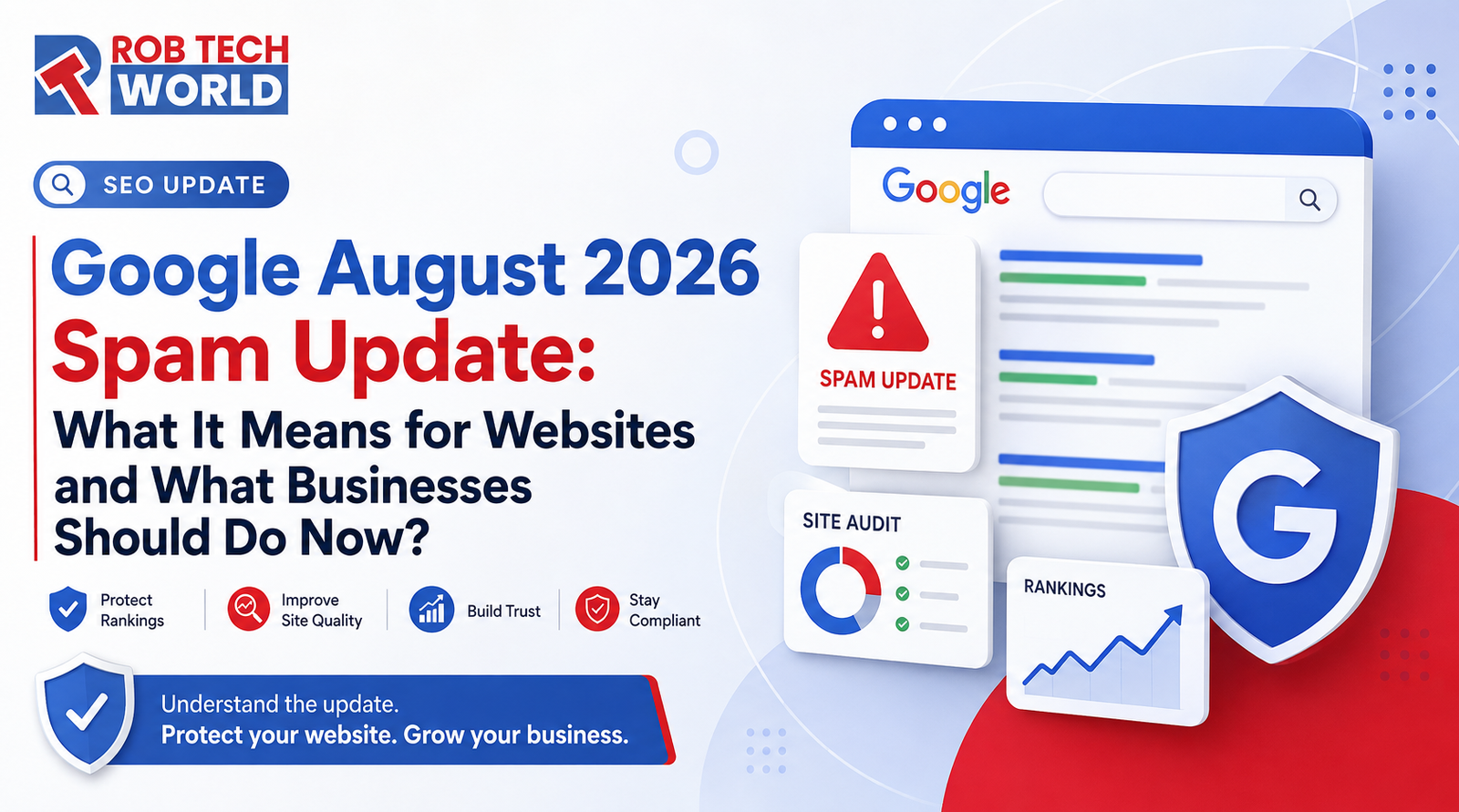
Google continues to refine its search systems to provide users with more useful, trustworthy, and relevant results. On August 18, 2026, Google began rolling out its latest Spam Update, making it an important development for website owners, SEO professionals, publishers, and businesses that depend on organic search traffic. The update is designed to improve Google’s ability to detect and address websites that violate its spam policies.
Unlike a traditional Google Core Update, the August 2026 Spam Update is specifically focused on search spam. This means businesses should pay particular attention to the quality of their website content, SEO practices, and overall approach to search optimization. Understanding what this update means and taking a measured approach can help websites maintain long-term search visibility.
What Is the Google August 2026 Spam Update?
The Google August 2026 Spam Update is a search algorithm update focused on improving Google’s spam detection systems. Google has not indicated that the update targets only one specific SEO technique. Instead, it is part of Google’s broader effort to identify websites and pages that use practices that violate its search spam policies.
The rollout began on August 18, 2026, and websites may experience ranking fluctuations while Google’s systems process the update. Some websites may see changes in impressions, rankings, or organic traffic, while others may see little or no noticeable impact.
It is important to understand that ranking fluctuations during a Google update do not automatically mean that a website has received a penalty. Search results can change for many reasons, including competitors gaining visibility, changes in search intent, algorithmic recalculations, and normal search volatility.
Why This Google Update Matters for Businesses?
Organic search remains an important source of traffic and leads for many businesses. A website that relies heavily on Google rankings needs to maintain a strong SEO foundation instead of depending on shortcuts designed only to manipulate rankings.
The latest spam update reinforces an important direction in modern SEO: websites should focus on providing genuine value to users. Pages created primarily to capture search traffic without offering meaningful information may have a greater risk of losing visibility as Google’s systems become better at evaluating search quality.
For businesses, this means SEO should not simply be about adding keywords, creating large numbers of pages, or building backlinks. The overall website experience, content usefulness, technical quality, relevance, and trustworthiness all need to work together.
Does the August 2026 Update Target AI-Generated Content?
One of the biggest questions businesses may have is whether this update means that AI-generated content is automatically at risk. The answer is more nuanced.
Using AI to assist with research, drafting, editing, or content development does not automatically make a page spam. The bigger concern is whether content is produced at scale without providing real value, originality, accuracy, or a useful experience for visitors.
A website publishing hundreds of nearly identical pages with little original information may create quality concerns regardless of whether those pages were written by humans or generated with AI. On the other hand, content supported by appropriate research, expert input, original insights, useful examples, and proper editing can provide genuine value.
Businesses should therefore focus less on whether AI was used and more on whether the final content actually deserves to rank.
Thin and Low-Value Content Deserves Attention
One of the first areas businesses should review after a spam-focused update is the quality of their existing pages.
A page that contains only a small amount of generic information, repeats content available elsewhere, or exists primarily to target a keyword may provide limited value to users. Websites with large numbers of similar pages should review whether every page serves a genuine purpose.
For example, creating separate pages for dozens of locations while changing only the city name can result in a poor user experience when those pages contain no meaningful local information. A better strategy is to create location-specific pages that provide genuinely useful information related to the customers, services, market, and search intent of that location.
Avoid Keyword Stuffing and Over-Optimization
Keywords remain an important part of SEO, but their use needs to be natural.
Repeating the same keyword excessively across headings, paragraphs, metadata, URLs, and anchor text does not make content more relevant. In fact, aggressive keyword usage can make content difficult to read and may create an unnatural optimization pattern.
Modern SEO should focus on understanding the topic and search intent rather than forcing an exact keyword into every possible location. Related terminology, natural language, useful explanations, and comprehensive coverage can help create a stronger page.
The goal should be to write for people first while making it easy for search engines to understand the subject of the page.
Review Your Link-Building Strategy
Backlinks remain an important part of SEO, but not every backlink provides equal value.
Businesses should review whether their link building strategy is focused on relevance and authority or simply on generating large numbers of links. Repeated submissions to low-quality websites, excessive use of exact-match anchor text, and links from irrelevant sources can create an unnatural profile.
This does not mean businesses should suddenly remove every backlink or stop all off-page SEO activities. Instead, the focus should shift toward relevant, trustworthy, and contextually appropriate sources.
A balanced SEO strategy should combine strong website content with legitimate digital PR, relevant industry mentions, useful resources, partnerships, and other forms of genuine authority building.
Don’t Panic If Rankings Change After August 18
A temporary ranking change does not necessarily mean that your website has been negatively affected by the spam update.
Google updates can create considerable volatility while systems are being recalculated. If your rankings or traffic have changed since August 18, the best approach is to first compare your current performance with historical data.
Google Search Console can help you evaluate changes in clicks, impressions, average position, and individual landing-page performance. Analytics data can provide additional information about organic traffic and user behavior.
Rather than reacting to one or two days of movement, businesses should observe trends while the rollout progresses and then investigate pages showing consistent declines.
Conduct a Complete SEO Audit
A Google update is also a good opportunity to perform a complete SEO audit.
A professional SEO audit can identify technical problems, indexing issues, duplicate content, weak internal linking, poor metadata, mobile usability problems, content gaps, and backlink-related concerns. These areas are already important components of a healthy search strategy, and a thorough audit can help businesses understand where their websites need improvement. Rob Tech World provides SEO audit services that combine technical analysis, content evaluation, keyword analysis, backlink review, competitor research, and actionable recommendations.
The objective should not be to make random changes simply because an algorithm update has been announced. Instead, an audit should identify genuine weaknesses and prioritize improvements that can strengthen the website over the long term.
Focus on Helpful and Original Content
The strongest response to a spam-focused algorithm update is to improve the usefulness of your website.
Every important page should have a clear purpose. Content should answer the questions users actually have, explain the subject thoroughly, demonstrate knowledge, and provide information that helps visitors make decisions.
Businesses can strengthen their content by adding original research, expert insights, real examples, useful explanations, comparisons, frequently asked questions, and information based on genuine experience.
This approach also supports broader SEO goals because useful content has a greater opportunity to attract organic links, engagement, branded searches, and returning visitors.
Improve Internal Linking and Website Structure
A strong website structure makes it easier for users and search engines to understand the relationship between different pages.
Important service pages should be supported by relevant informational content, while blog articles should naturally connect to appropriate service or category pages. Internal links should help visitors discover additional information rather than being added simply to manipulate rankings.
For example, a website providing SEO services can connect educational articles about technical SEO, content optimization, keyword research, SEO audits, and performance tracking with relevant service pages. This creates a logical information architecture while helping users move through the website.
What Businesses Should Do During the Update?
The best strategy during the August 2026 Spam Update is to remain calm and focus on fundamentals. Website owners should monitor Google Search Console and analytics data, review their highest-value pages, examine content quality, check technical SEO health, and evaluate their link-building practices.
Businesses should avoid making hundreds of changes at once. If a website changes its content, internal links, URLs, metadata, backlinks, and technical setup simultaneously, it becomes difficult to determine what actually affected performance.
A controlled approach is more effective. Identify potential problems, prioritize the most important ones, implement improvements carefully, and monitor the results.
How Rob Tech World Can Help Businesses Adapt to Google’s Changing Algorithms?
Search algorithms continue to evolve, making it increasingly important for businesses to build SEO strategies around quality rather than short-term ranking techniques.
Rob Tech World works across SEO, technical SEO, content optimization, SEO audits, performance tracking, website development, and digital marketing. Its approach focuses on data-driven strategies and measurable business outcomes rather than relying only on automated reports or isolated ranking metrics.
For businesses affected by ranking fluctuations, the first step should be understanding what changed and why. A detailed website analysis can help identify technical problems, content weaknesses, search-intent gaps, competitive changes, and opportunities for sustainable growth.
Final Thoughts on the Google August 2026 Spam Update
The Google August 2026 Spam Update is another reminder that sustainable SEO requires more than keywords and backlinks. Websites that consistently provide useful information, maintain strong technical foundations, understand search intent, and follow ethical SEO practices are better positioned for long-term organic visibility.
Businesses should not react to the update by making unnecessary changes or abandoning SEO. Instead, this is an opportunity to review the health of the website, improve weak content, strengthen user experience, and make sure every SEO activity has a genuine purpose.
Google’s algorithms will continue to change, but the fundamental objective remains consistent: create websites that users can trust and genuinely benefit from. A quality-first SEO strategy is therefore not just a response to the August 2026 Spam Update; it is a foundation for sustainable search growth.
Frequently Asked Questions About Google’s August 2026 Spam Update
How long will the Google August 2026 Spam Update take to complete?
Google’s spam update rollout can take several days to complete. During this period, search rankings may fluctuate as Google’s systems process and reassess websites. It is better to wait until the rollout settles before making major SEO decisions based on short-term ranking changes.
Can a website recover after losing rankings during a spam update?
Yes, recovery can be possible when ranking losses are connected to issues that can be corrected. Website owners should identify potential quality or spam-policy concerns, improve affected pages, strengthen the overall website, and continue following Google’s search guidelines rather than relying on quick ranking fixes.
Should I stop publishing new blog content during the update?
No, there is generally no reason to stop publishing useful content. New articles can continue to be published as long as they are created for users, provide original value, match search intent, and are not produced simply to generate large numbers of keyword-targeted pages.
Should old or underperforming pages be removed?
Not every underperforming page needs to be deleted. First evaluate whether the page has useful information, backlinks, traffic potential, or strategic value. Where appropriate, weak pages can be improved, consolidated with stronger content, redirected, or removed when they provide no meaningful value.
How can I check whether my website has been affected?
Google Search Console is one of the most useful places to investigate changes. Compare organic clicks, impressions, average position, and individual page performance before and after August 18, 2026. Looking at several days of data is more reliable than judging the impact from a single day.
Is a sudden drop in traffic always caused by the spam update?
No. Traffic can change because of competitors, seasonal demand, search trends, technical problems, indexing changes, SERP features, manual actions, or other Google algorithm changes. A proper analysis should compare multiple data sources before connecting a traffic decline specifically to the August 2026 Spam Update.