







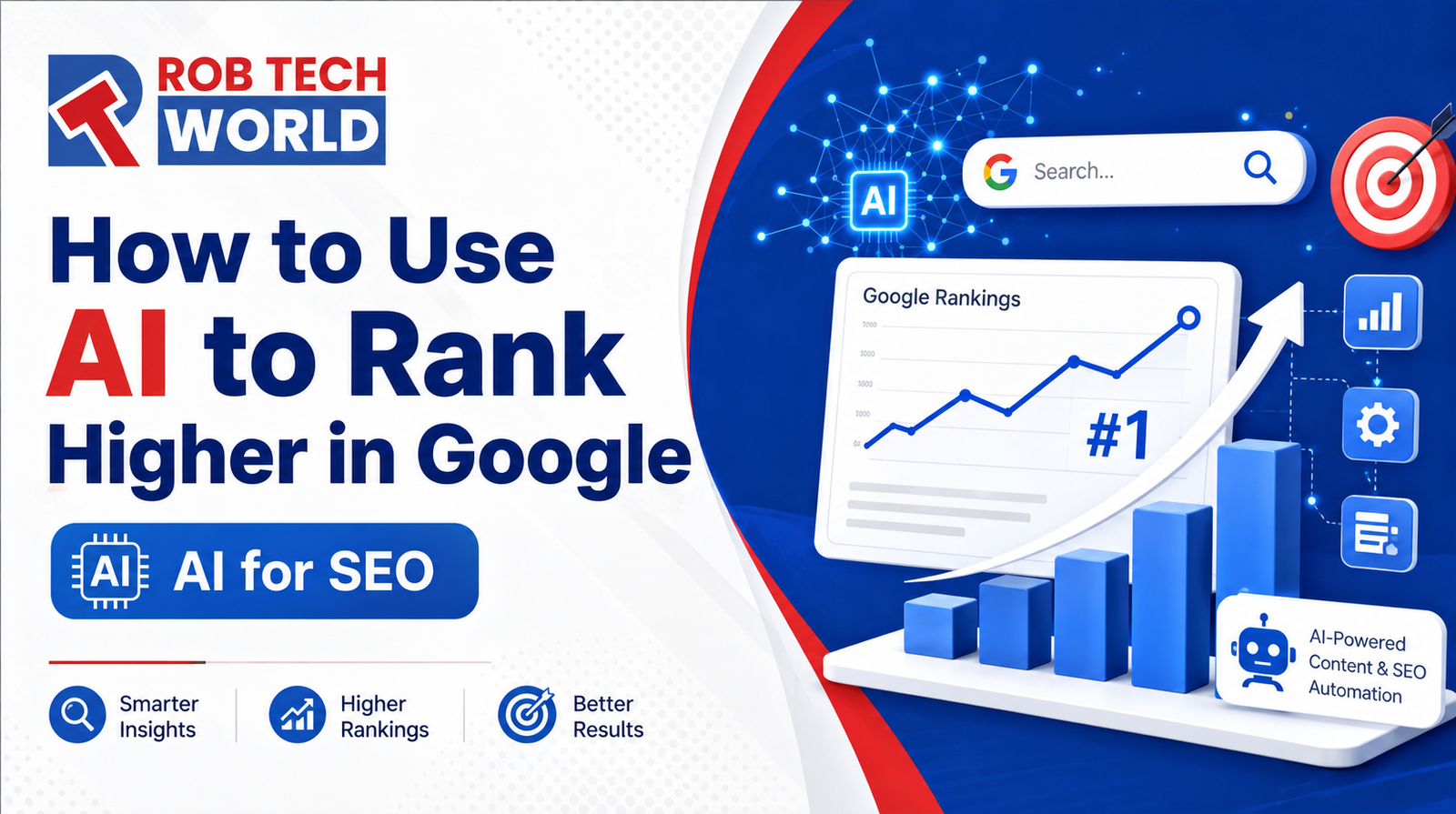
Search engine optimization is no longer limited to manually researching keywords, writing articles, and waiting for rankings to improve. Artificial intelligence has changed the way businesses approach search visibility by making research, content planning, competitor analysis, technical checks, and performance monitoring more efficient. When used correctly, AI can help businesses understand search intent, discover content opportunities, improve existing pages, and build a more organized SEO strategy. For businesses looking to strengthen their online presence, combining AI with a thoughtful search engine optimization strategy can create a more efficient path toward sustainable Google visibility.
AI, however, should not be treated as a shortcut that automatically places a website at the top of Google. Search engines continue to evaluate relevance, usefulness, originality, experience, and overall website quality. The strongest approach is to use AI as a support system while human expertise remains responsible for strategy, accuracy, brand voice, and final decisions. This balance allows businesses to save time without producing generic content that provides little value to readers.
Understanding the Role of AI in Modern SEO
Artificial intelligence can process large amounts of information much faster than a person working manually. In SEO, this capability can be useful for identifying patterns in search results, organizing keyword ideas, understanding topics, analyzing content gaps, and finding areas where a website could improve. Instead of replacing the SEO process, AI can make individual stages of that process more efficient.
For example, an AI tool can help organize a large collection of search queries according to their themes and potential intent. It can also help identify whether users are looking for information, comparing services, researching products, or preparing to make a purchase. This information can influence the structure of a page and the type of content that should be created.
AI can also assist with content briefs, title ideas, frequently asked questions, internal linking opportunities, and content refreshes. The important point is that these outputs should be reviewed before publication. AI-generated suggestions can sometimes be inaccurate, repetitive, or disconnected from the actual needs of a target audience.
Start With Better Keyword and Search Intent Research
Best Keyword research remains an important part of SEO, but AI can make the process more intelligent. Instead of focusing only on high-volume phrases, businesses can use AI to group related searches and understand the questions behind them. This helps create content that addresses a complete topic instead of repeating one phrase throughout a page.
AI can identify variations of a primary search term, related questions, long-tail queries, and conversational phrases. These insights can then be compared with actual Google search results to understand what type of content is already performing well. The goal should not be to copy competing pages but to determine what users expect and where the website can provide something more useful.
Search intent should guide the final strategy. If people searching for a phrase are mainly looking for educational information, a sales-heavy landing page may not satisfy them. Similarly, if users are ready to purchase a service, a general informational article may not be the best result. AI can help identify these patterns, but human review is essential before deciding how a page should be positioned.
Use AI to Improve Existing Content
Creating new pages is not always the fastest way to improve organic visibility. Many websites already have useful content that could perform better with strategic improvements. AI can help identify areas where existing pages may be too short, repetitive, outdated, poorly structured, or missing important subtopics.
A content optimization process can compare the current page with relevant search results and identify useful topics that may need stronger coverage. AI can also suggest better heading structures, clearer introductions, related questions, internal linking opportunities, and areas that require additional explanation.
The objective should never be to increase word count simply because competing pages are longer. A 1,000-word page can outperform a 2,000-word page if it provides clearer, more accurate, and more useful information. AI should therefore be used to improve usefulness rather than inflate content unnecessarily.
Create Helpful Content With Human Oversight
One of the biggest mistakes businesses can make with AI for SEO is publishing large quantities of automatically generated articles without proper editing. Search engines are designed to provide useful results to users, so content that feels generic, repetitive, inaccurate, or created only to manipulate rankings can weaken a website’s overall quality.
AI can be extremely useful during the research and drafting stages, but human expertise should shape the final material. A knowledgeable writer can add examples, practical insights, original observations, brand expertise, and information that genuinely helps readers.
At Rob Tech World, AI can be viewed as a productivity tool rather than a replacement for SEO expertise. The strongest content strategy combines automation with human judgment so that every page has a clear purpose, natural language, useful information, and a reason for the reader to continue exploring the website.
Strengthen On-Page Optimization With AI
On-page SEO includes many elements that influence how search engines and users understand a webpage. AI can help review titles, headings, descriptions, content structure, keyword placement, semantic relationships, and internal links. It can also identify sections where the page may not clearly answer the user’s main question.
However, optimization should always remain natural. Repeating the same keyword excessively can make content uncomfortable to read and may create an impression of manipulation. A better approach is to use relevant terminology naturally while focusing on the topic as a whole.
AI can also help identify opportunities to connect related pages through contextual internal links. For example, a service page can naturally reference an educational guide, while a blog article can direct readers toward a relevant service page. This improves navigation and helps search engines understand relationships between different sections of a website.
Use AI for Technical Website Analysis
Technical Website SEO can become complicated as a website grows. Large websites may contain broken links, duplicate pages, incorrect redirects, indexing problems, slow-loading resources, missing metadata, or structural issues. AI can assist by organizing technical information and highlighting patterns that deserve attention.
An AI-assisted technical review can help prioritize problems based on their potential impact. Instead of treating every issue as equally important, businesses can focus first on problems affecting crawlability, indexing, page experience, important landing pages, and website accessibility.
AI can also help interpret technical reports and explain complicated findings in simpler language. Nevertheless, technical recommendations should be verified before implementation because an automated tool may misunderstand a website’s architecture or recommend a change that is unsuitable for a particular setup.
Analyze Competitors More Intelligently
Competitor research becomes more valuable when AI is used to identify patterns rather than simply collect competitor keywords. AI can help analyze the types of pages competitors have created, the subjects they cover, their content structure, frequently discussed topics, and potential gaps in their strategies.
The purpose of this research should not be to duplicate another website. Instead, businesses should discover opportunities to create something more useful or more specific. A competitor may rank for a broad topic while leaving important questions unanswered. Another website may have strong informational content but weak service pages. These differences can reveal opportunities for a better SEO strategy.
AI can help organize these findings into themes, making it easier to decide which pages deserve attention first. Human analysis should then determine whether those opportunities are relevant to the business and its audience.
Improve Local Search Visibility
For businesses serving specific cities or regions, AI can also support local SEO planning. It can help organize location-based search queries, identify common customer questions, develop locally relevant content ideas, and compare how competitors present their services in particular markets.
Local optimization should go beyond adding a city name repeatedly to webpages. Businesses should provide genuinely useful local information, maintain accurate business details, develop relevant service pages, and create content that reflects the needs of their target market.
AI can help identify patterns in local searches, but real-world business knowledge remains important. Information about service areas, customer expectations, availability, and local differences should always be verified by the business before being published.
Use AI to Build a Smarter Link-Building Strategy
Links from relevant and trustworthy websites can contribute to a strong SEO profile. AI can help identify potential outreach categories, research relevant publications, organize prospects, and suggest content topics that may naturally attract references.
The focus should remain on quality and relevance rather than acquiring a large number of links. Unrelated or low-quality links created only for ranking manipulation can provide little value. A stronger approach is to build useful resources, contribute genuine expertise, create shareable research, and develop relationships with relevant websites.
AI can make the research and organization process faster, but relationship building and outreach still require a human approach. Personalized communication is generally more meaningful than sending identical automated messages to hundreds of websites.
Track SEO Performance With AI
SEO performance should be measured consistently because rankings and search behavior can change over time. AI can help summarize performance data, identify unusual changes, compare periods, and highlight pages that deserve closer attention.
Businesses can use AI to review trends across organic clicks, impressions, rankings, landing pages, conversions, and engagement metrics. This can make large amounts of data easier to interpret. For example, if a page receives more impressions but fewer clicks, the issue may involve search intent, title presentation, or competition in the search results.
Performance monitoring should not focus exclusively on keyword positions. Traffic quality, conversions, leads, engagement, and business outcomes are equally important. A keyword ranking improvement has limited value if it does not attract the right audience.
Combine AI With Content Strategy
AI works best when it is connected to a clear content strategy. Businesses should first determine which audiences they want to reach, what problems those audiences have, and which services or products can solve those problems. AI can then help organize topics around those business goals.
A well-planned content ecosystem may include educational articles, service pages, comparison content, FAQs, guides, and supporting resources. Each page should have a specific purpose and should connect naturally with other relevant pages.
Content should also be reviewed regularly. Information can become outdated, search intent can change, and competitors can publish stronger resources. AI can help identify pages that may need updates, but the final decision should consider accuracy, business relevance, and user expectations.
Avoid Common AI SEO Mistakes
Using AI does not guarantee better rankings. One common mistake is publishing content without fact-checking. Another is creating several pages that target nearly identical topics, resulting in unnecessary duplication. Some businesses also rely heavily on AI-generated language that sounds polished but lacks original value.
Another problem is over-optimization. SEO should support the reader rather than interrupt the reading experience. Keywords, related terms, internal links, headings, and metadata should all be used naturally.
AI can also create false confidence because its output may sound authoritative even when the information is incorrect. Every important claim should therefore be checked, especially when content involves technical, financial, legal, medical, or rapidly changing subjects.
The Future of AI-Powered SEO
AI is likely to become even more integrated into SEO workflows as search technology evolves. Businesses will increasingly use AI to understand complex queries, identify content opportunities, automate repetitive analysis, and interpret large datasets.
At the same time, originality and genuine expertise will remain valuable. When many websites can generate similar AI-written content, businesses that provide first-hand knowledge, original research, useful experiences, expert opinions, and genuinely helpful resources can stand out more effectively.
The future of SEO is therefore not simply about using more AI. It is about using AI intelligently. Automation can handle repetitive work, while people remain responsible for creativity, strategy, quality control, and understanding customers.
How Businesses Can Start Using AI for SEO
A practical AI SEO workflow can begin with an audit of the existing website. After identifying technical weaknesses and content opportunities, businesses can use AI to organize keyword themes, understand search intent, evaluate competitors, improve existing pages, and develop a content roadmap.
The next stage should focus on implementation and measurement. Pages can be improved based on the research, internal links can be strengthened, technical problems can be addressed, and new content can be created where genuine gaps exist. Performance should then be monitored to determine what is working and where further improvements are required.
This approach creates a sustainable system rather than a short-term ranking experiment. AI becomes part of the workflow while the overall strategy remains focused on users, relevance, quality, and business objectives.
Conclusion
AI has made SEO faster, more data-driven, and easier to scale, but it does not replace strategic thinking. Businesses that want to rank higher in Google should use AI to support research, content planning, optimization, technical analysis, competitor research, local visibility, link-building preparation, and performance evaluation.
The most effective approach is to combine automation with human expertise. AI can identify patterns and accelerate repetitive tasks, while experienced SEO professionals can decide what those insights actually mean for a business. When both work together, websites can produce more relevant content, improve user experience, identify valuable opportunities, and build a stronger organic search presence.
For businesses seeking a long-term approach to organic growth, AI should be treated as an intelligent assistant rather than a ranking shortcut. With the right strategy, careful optimization, useful content, and continuous measurement, AI for SEO can become a powerful part of a modern digital marketing process.
Frequently Asked Questions
Can AI really help a website rank higher on Google?
Yes, AI can support many SEO activities that contribute to better rankings, including keyword research, search intent analysis, content improvement, competitor research, technical analysis, and performance monitoring. However, AI alone cannot guarantee rankings. The quality and relevance of the final website experience remain critical.
Is AI-generated content good for SEO?
AI-generated content can be useful when it is properly researched, edited, fact-checked, and improved with genuine expertise. The problem occurs when businesses publish large amounts of generic content without adding meaningful value. AI should support content creation rather than become a reason to produce low-quality pages at scale.
How can AI help with keyword research?
AI can organize search terms into related themes, identify long-tail variations, suggest relevant questions, and help understand different types of search intent. These suggestions can then be validated against actual search results and business objectives before being included in an SEO strategy.
Can AI perform a complete SEO audit?
AI can assist with many parts of an SEO audit by analyzing technical information, content structure, metadata, links, and performance data. However, a complete audit still requires human interpretation. Website architecture, business priorities, search intent, and implementation risks need professional evaluation.
Does using AI mean I need fewer SEO professionals?
AI can reduce the amount of repetitive manual work involved in SEO, but skilled professionals remain important. Strategy, quality control, technical decision-making, content expertise, competitor interpretation, and understanding customer behavior require judgment that automated systems cannot consistently provide.
How often should AI SEO analysis be performed?
There is no universal schedule because it depends on the size and activity of a website. Performance monitoring can be continuous, while deeper content and technical reviews can be performed periodically. Important changes in traffic, rankings, website structure, or search behavior should also trigger additional analysis.
What is the best way to start with AI for SEO?
Start by identifying the biggest SEO opportunities on your website instead of immediately generating new content. Review technical health, existing content, search intent, competitors, and performance data. Then use AI to organize research and accelerate improvements while keeping human review at every important stage. This creates a more reliable foundation for sustainable organic growth.